
Why Hungary Matters
Six big-picture conclusions from Orbán’s smashing defeat – and what it all means for the transnational struggle against rightwing authoritarianism

This essay is cross-posted from Steady, where Democracy Americana is now mainly hosted.
I am also making it available here for those who prefer to read (and perhaps share!) the piece in the Substack app. If you want to support my work, you can head over to Steady and become a paid subscriber.
The intro to this piece is free for everyone. If you want to read more than the preview or gain access to the audio version of the newsletter, please consider becoming a paid member of Democracy Americana, which is solely funded by readers and constitutes my main source of income as an independent writer.
Without your support, I will not be able to continue this work. Please know that I am immensely grateful for your generosity!
If a paid membership is currently not an option, the best way to support Democracy Americana is to share this piece here on Substack as well as on social media - and recommend my work to people you think might be interested.
You can also subscribe to the free version of the newsletter here on Substack: I will transfer all new subscribers coming in here over to Democracy Americana’s new home to make sure you are not missing anything.
It is rare that the political discourse across the “West” is dominated by one single event. And when it happens, it’s often not a good sign: Wars and natural disasters can have that effect, or perhaps the latest victory of an extremist party in what can sometimes feel like a steady march towards inevitable authoritarian triumph.
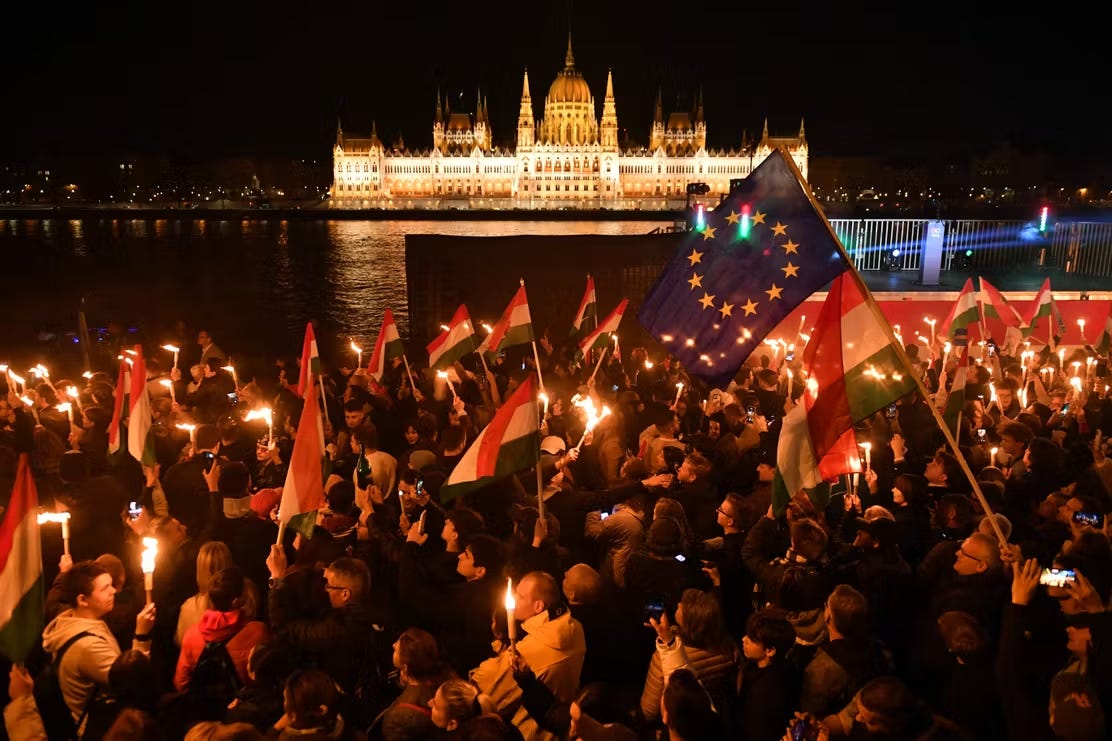
But yesterday, all our attention was focused on what turned out to be a massive defeat for the global Far Right: In Hungary, Viktor Orbán lost the parliamentary election. And it was a blowout.
Orbán’s Fidesz party got only 38 percent – Tisza, the party of his main opponent Péter Magyar received 53 percent. Crucially, this result translates to a two-thirds supermajority, 138 out of 199 seats, for Tisza in Parliament, which could enable them to actually undo much of the authoritarian system Orbán has entrenched.
Perhaps never before have so many people paid so much attention to a parliamentary election in a small, economically weak, and geostrategically unassuming (at least in a traditional sense) country. Across the political spectrum, Viktor Orbán is rightfully seen as the symbol of the rise of “illiberalism”: He has undoubtedly been one of the defining figures in the transnational authoritarian assault on democracy and the rule of law. And after sixteen years in power, Orbán’s time as prime minister of Hungary is about to end. The people of Hungary have had enough, and they found a way to make that count.
I am not going to pretend I am an expert on Hungarian society and politics. But as my work focuses on democracy and its discontents in the United States, and how the American conflict over democracy is connected to the inter- and transnational struggle between authoritarian ethno-nationalism and democratic pluralism, I want to reflect on the broader meaning of what transpired yesterday, on the conclusions we can draw and the lessons we may or may not be able to learn.
As I am writing this, less than 24 hours have passed since the first results from the Hungarian election were made public – so take this as a preliminary attempt to provide perspective on what I believe was a truly significant outcome. More specifically, let’s discuss:
- Why we need to remember, amidst all the well-earned celebration, that this struggle is not over, and there is no such thing as a decisive “turning point”
- What we have learned about the nature and inner dynamics of regimes that are best described as forms of competitive authoritarianism
- Why the American Right has been so obsessed with Orbán in the first place
- What that transnational fixation on Orbán can tell us about the world-historic stakes in this broader struggle over democracy
- And why we must never give in to defeatism or the temptation to perpetuate rightwing assertions of liberal democracy’s supposedly inevitable fall.
Nothing about rightwing authoritarianism is inevitable.
1
This struggle is not over
Don’ worry, I am not going to indulge in some reflexive contrarianism and tell you that Orbán’s defeat was not a big deal. This was unequivocally a good thing. Something significant happened yesterday in Hungary.
And yet, I do want to start with a word of caution…
The rest of this piece is reserved for paid members of Democracy Americana.
If you are not a member, but still want to read Democracy Americana, fear not: I will keep publishing free long-form essays regularly.
But if you can, please consider becoming a paid member over on Steady: You’ll gain access to additional member-exclusive essays every week - and members also have access to the audio versions of all my writing in podcast form wherever you get your podcasts.
Most importantly, if you value this independent work, please know that it is your support and your generosity that is making it possible. Democracy Americana is entirely reader-supported and my main source of income as an independent writer.